
YouTube MCP servers compared: one video or a whole library?
A YouTube MCP server lets Claude, ChatGPT or Cursor read YouTube through tools. Most servers read one video per call; a library server searches the stored transcripts of the channels you follow in a single call, with timestamps. Pick by the question you want to ask.
Key takeaways
- Claude cannot watch a video: a YouTube MCP server gives it text, and the amount of text it can reach in one call is what matters.
- Data API servers are best for metadata and need a YouTube API key, limited by default to 100 searches a day per project.
- Transcript fetchers are free and simple, but read one video per call.
- A library server like Tube Operator searched the 155 videos pulled from 11 followed channels in one call and returned timestamped passages (3 or 4 of the 10 results were on topic).
- Search compares characters, not meaning: use specific phrases, then ask Claude to verify each excerpt before answering.
What does a YouTube MCP server actually do?
A YouTube MCP server gives an AI assistant like Claude, ChatGPT or Cursor tools, through the Model Context Protocol, to search YouTube, read metadata and above all read transcripts. Claude cannot watch a video: everything it knows about one comes from text, so the real question is how much of that text the server can give it, and how fast.
Every server we looked at falls into one of three families. The family matters more than the brand, because it decides what you can ask.
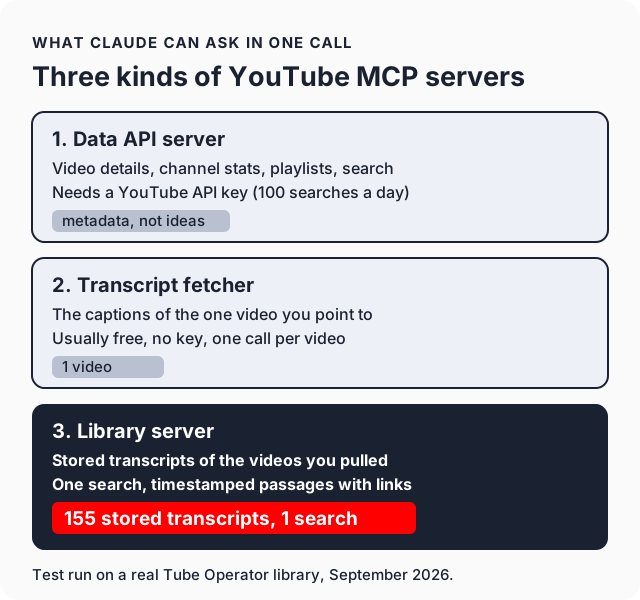
- Data API servers wrap the official YouTube Data API. They are good at metadata: video details, channel statistics, playlists, search. They need your own API key and share its daily quota.
- Transcript fetchers pull the captions of one video when you give them a link or an ID. They are simple and often need no key, but each call covers a single video.
- Library servers keep a persistent, pre-transcribed collection of channels and let the assistant search across all of it in one call. Tube Operator is the only server of this kind we found among those ranking for "youtube mcp" (Google results checked on September 24, 2026).
Which YouTube MCP servers exist, and how do they differ?
We read the documentation of the servers that rank on Google for "youtube mcp" and of a selection of the open-source projects cited in comparisons. This is what each one actually offers, as documented on September 24, 2026.
| Server | Family | Needs a YouTube API key | Transcripts | All of a channel's transcripts in one call |
|---|---|---|---|---|
| ZubeidHendricks/youtube-mcp-server | Data API | Yes | One video per call (transcripts_getTranscript) |
No |
| anaisbetts/mcp-youtube | Transcript fetcher | No | One video per call | No |
| jkawamoto/mcp-youtube-transcript | Transcript fetcher | No | One video, paginated for very long transcripts | No |
| ytmcp.com | Data and transcripts | No YouTube key: a ytmcp account key (sign-in required) | Per video, with timestamps | Not documented on its site |
| Tube Operator | Library | No (OAuth, or a Tube Operator key) | Any video by link (1 credit) or pulled from followed channels; stored in your library | Yes, across the videos already pulled (search, get_channel_transcripts) |
Each open-source row links to the project's GitHub page, where these details are documented. The only side-by-side comparison on Google's first page for "youtube mcp" (September 24, 2026) is Ekamoira's. It compares setup complexity, GitHub stars and features, but does not run the servers in Claude, test several videos at once or show a timestamped answer.
Can Claude search a whole YouTube channel through MCP?
A list of tools does not tell you what the assistant can do with them, so we ran a real query through the Tube Operator MCP server, from Claude, on an actual library: eleven followed channels, including Alex Hormozi, Y Combinator, Andrew Huberman, Cody Schneider, TED-Ed and Khan Academy, with 155 videos already transcribed.
The question was deliberately broad: which passages talk about price? One search call, capped at ten results, returned passages from several channels, in English and in French. Only three or four of the ten were really about pricing. The others were noise of two kinds: the string inside unrelated words ("caprice", "priceless", the French "proprices"), and everyday mentions of a price in off-topic videos, such as the cost of a nightstand in an Architectural Digest home tour. Each result came with the video title, its YouTube link, and an excerpt from the transcript or the video's breakdown with minute markers, so Claude could cite a precise moment instead of paraphrasing from memory. For example, in Learn Email Marketing in 39 Minutes, at 19:33, Alex Hormozi argues that an annual fee worth about one to three months of subscription adds 8 to 24% to revenue without adding cost.
The same test also showed the main limit, and it is worth knowing before you rely on it. The search compares characters, not meaning. More specific phrases ("pricing strategy", "raise prices") reduce both kinds of noise, and asking Claude to check that each excerpt is actually relevant before it answers removes the second. In practice, treat the first search as a list of candidates, then narrow it with one or two more precise searches.
Compare that with a transcript fetcher. To answer the same question over the same channels, the assistant would first need the list of 155 video IDs, then one tool call per video, then read everything in its context window. With a data API server, listing the channel's videos would also draw on your project's YouTube Data API quota (by default, 100 search.list calls a day, plus 10,000 units for other endpoints). For a single video, both approaches work well. For "what does this creator say about X across everything I have pulled", a library starts from one search over every pulled transcript instead of 155 transcript calls, then narrows it with one or two more specific searches.
How to connect a YouTube MCP server to Claude, ChatGPT or Cursor
The steps differ by client, not much by server. Here is the setup for Tube Operator, taken from its API and MCP documentation. The server URL is https://app.tubeoperator.io/mcp, and MCP access requires the Pro plan or above.
Claude (desktop app and claude.ai)
- Open Settings, then Connectors, and choose Add custom connector.
- Name it Tube Operator and paste the server URL.
- Click Connect, sign in, then Allow. Enable the connector in the chat tools menu.
ChatGPT
- In Settings, open Apps and Connectors, then Advanced settings, and turn on Developer mode.
- Create a new connector named Tube Operator with the server URL and OAuth authentication.
- Sign in and allow access. The connector is then available in chats, from the plus menu, and in Deep Research.
Claude Code
claude mcp add --transport http tube-operator https://app.tubeoperator.io/mcp
Then run /mcp and choose Authenticate.
Cursor
Add the server to ~/.cursor/mcp.json (or .cursor/mcp.json in a project), with an API key created in Tube Operator under Settings, then API and MCP:
{
  "mcpServers": {
    "tube-operator": {
      "url": "https://app.tubeoperator.io/mcp",
      "headers": { "X-Api-Key": "ytr_your_key" }
    }
  }
}
Open-source servers follow the same pattern in Claude Desktop and Cursor, except that you run them locally (npx for Node servers, uvx or pip for Python ones) and pass your YouTube API key as an environment variable when the server needs one (for example YOUTUBE_API_KEY for ZubeidHendricks/youtube-mcp-server).
Which YouTube MCP server should you use?
Start from the question you want to ask, not from the server.
| What you want | Best fit | Why |
|---|---|---|
| Summarize or quote one video you already have the link to | A transcript fetcher | Free, no key, one call |
| Channel statistics, view counts, playlists | A data API server | It exposes the official metadata |
| Ask what a creator says about a topic across all their videos | A library server | One search over every pulled transcript gives timestamped candidates to narrow down |
| Compare what several creators say about the same question | A library server | Search spans all followed channels at once |
| Build a repeatable research workflow in Claude Code or Cursor | A library server with an API key | The collection persists between sessions |
A practical setup is to use both: a free transcript fetcher for one-off links, and a library for the channels you keep learning from. If you are in the second case, the use cases page shows what a library looks like for business, startups, health and learning channels.
What does a YouTube MCP server cost, and what are its limits?
- Open-source servers are free to run, but the ones built on the YouTube Data API consume your project's quota, and servers that download transcripts with yt-dlp (anaisbetts/mcp-youtube, for example) depend on it keeping up with YouTube changes.
- Hosted servers trade setup for a subscription or credits. Check what happens when you run out: Tube Operator, for instance, returns an HTTP 402 error when the credit balance is insufficient, and MCP access requires the Pro plan or above.
- Context size is the hidden cost of transcript fetchers: the transcript of the 39-minute Hormozi video above is 9,794 words, roughly 13,000 tokens. If the 155 videos of the test library averaged that length, loading them one by one would mean around two million tokens, far beyond what an assistant can hold in one conversation. A library search returns only the matching passages.
Whichever you pick, test it with your real question first. The fastest way to see the difference is to follow one channel you already learn from and ask Claude something only its full archive can answer. You can start a 7-day free trial of Tube Operator on the Pro plan, which includes MCP access, to try exactly that.
Frequently asked questions
Is there an MCP server for YouTube?
Yes, several. Open-source options include ZubeidHendricks/youtube-mcp-server (YouTube Data API, needs a key), anaisbetts/mcp-youtube and jkawamoto/mcp-youtube-transcript (transcripts, one video at a time). Other options include ytmcp.com (sign-in and its own API key) and Tube Operator (OAuth or its own API key), which keeps a searchable library of the videos you pull from the channels you follow.
Can Claude watch YouTube videos?
No. Claude reads text, not video. Through an MCP server it can read a video's transcript, and with a library server it can search the stored transcripts of the videos pulled from the channels you follow.
Do I need a YouTube API key to use a YouTube MCP server?
Only for servers built on the official YouTube Data API. Transcript fetchers usually need no key, and Tube Operator connects with OAuth or its own API key.
How do I connect a YouTube MCP server to Cursor?
Add the server to ~/.cursor/mcp.json or .cursor/mcp.json in your project, with its URL and any required header. For Tube Operator, the URL is https://app.tubeoperator.io/mcp with an X-Api-Key header.
Turn the channels you learn from into a library your AI can read
Seven days free, from $9/month, cancel anytime.